

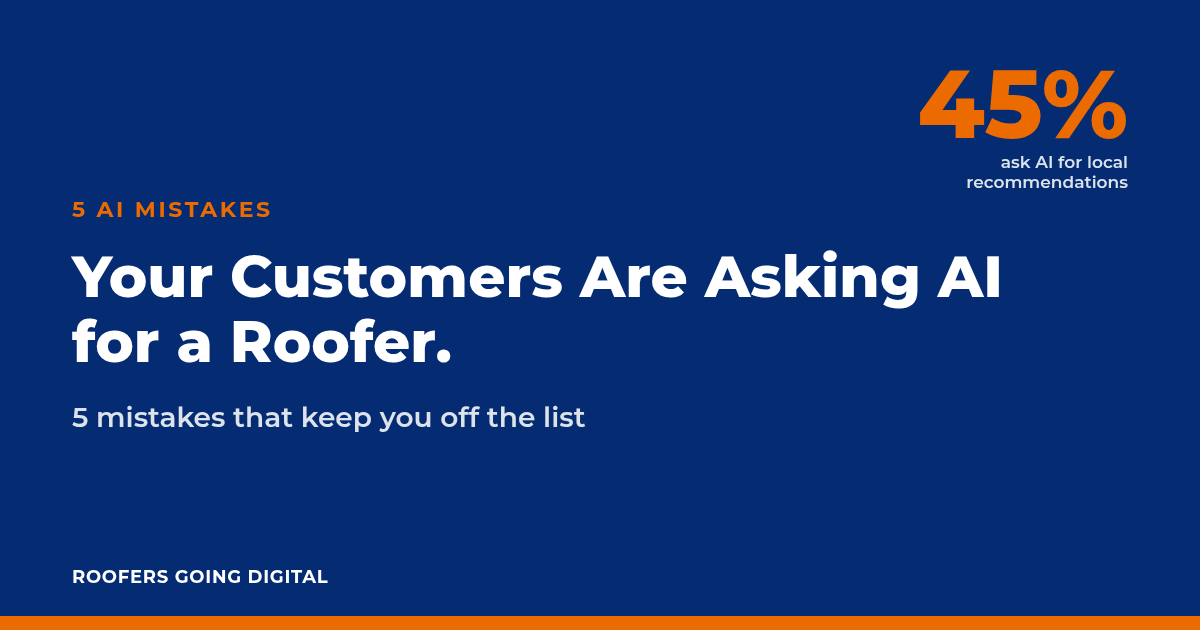
A year ago, few people asked ChatGPT to find a local business. Now almost half of consumers do.
In BrightLocal’s 2026 survey of 1,002 US adults, 45% said they used ChatGPT or another AI tool for local recommendations, up from 6% the year before (BrightLocal, Feb 2026).
That’s the homeowner after a hailstorm typing “who’s a good roofer near me.” It’s also the property manager who needs three bids by Friday and asks for a shortlist before calling anyone. In both cases, the AI hands over a few names. Either you’re one of them or you never hear about that job.
Roofers are not ignoring AI on purpose. They’re busy running jobs. But a few common mistakes keep good roofing companies off that list. Here are five, in the order we’d fix them.
Mistake 1: Ignoring how your customers search now
The old path was simple: Google, a few clicks, a phone call. Today a lot of customers skip the clicks. They ask a question and read the answer.
To put you in that answer, an AI tool needs something to go on: pages that explain what you do, where you work and what a job looks like, a Google Business Profile that is complete, and reviews that say the same thing in customers’ words.
Many roofing websites were built to look good, not to answer questions. A homeowner wants to know what a roof replacement costs in your area, how long it takes, what shingles or metal options make sense, and how you handle an insurance claim. A property manager wants to know if you do TPO or coatings, whether you take maintenance contracts and how you report on a building with 40 units.
What to do: list the 20 questions your estimators hear most, from homeowners and from property managers. Answer each one on your site in plain words, one page or one section per question. Fill in every field of your Google Business Profile, including services and service areas.
Mistake 2: Letting your reviews go stale
AI tools now read your reviews before your customer does. 82% of consumers say they read AI-generated review summaries (BrightLocal, Feb 2026). If your last good review is from 2023, that summary says so.
The same survey shows how picky customers are:
- 47% won’t use a business with fewer than 20 reviews.
- 74% only care about reviews written in the last three months.
- 89% expect the owner to respond to reviews.
A roofing company with 150 great reviews from three years ago can lose to one with 40 reviews from this season, with replies on every one.
What to do: ask for a review at the moment the customer is happiest, usually at the final walkthrough or when the job is paid. Make it one tap with a direct link by text. Reply to every review, good or bad, within a few days. For commercial work, ask the property manager or facility director, not just the building owner. We wrote more on this in how to manage Google reviews.
What your customer checks before calling
- 45%
ask ChatGPT or another AI tool for local recommendations (up from 6% a year earlier)
- 47%
won't use a business with fewer than 20 reviews
- 74%
only care about reviews from the last three months
Mistake 3: Publishing AI content with no roofer checking it
AI can write a blog post in 30 seconds. That’s the problem. Every roofer in your market can do the same, and the result reads the same: “Your roof is one of the most important parts of your home.”
There are also fewer clicks to win. When Google shows an AI summary at the top, people click less. Pew Research Center tracked the real browsing of 900 US adults in March 2025: people clicked a regular search result in 8% of visits with an AI summary, compared with 15% without one. They clicked a link inside the AI summary in just 1% of visits (Pew Research Center, Jul 2025). Google disputes Pew’s method. Ahrefs, using different data, points the same way.
Comparing 150,000 keywords with an AI Overview (December 2025) against 150,000 without one, Ahrefs found that an AI Overview correlates with a 58% lower average clickthrough rate for the top ranking page (Ahrefs, Feb 2026).
So the page that does get the click has to earn it. A generic post won’t. A post with your local code requirements, real photos from your jobs, the questions your crew actually gets and the price ranges you actually see will.
What to do: use AI for the first draft if you want. Then have someone who has been on a roof read every line. Add what only you know: your market, your materials, your process, your photos. Cut anything you wouldn’t say to a customer’s face. Our Google strategy for roofing companies covers the rest of the basics.
Where the clicks go when Google answers first
- 15%
of visits end in a click on a search result when there is no AI summary
- 8%
when there is an AI summary
- 1%
click a link inside the AI summary
Mistake 4: Buying AI tools before fixing the basics
There is no shortage of AI tools for contractors: chatbots, AI receptionists, AI estimators, AI ad builders. Most of them assume the basics already work.
Even among larger exterior contractors, the basics aren’t there yet. ServiceTitan surveyed over 1,000 roofing and exterior companies with more than $5M in revenue: only 25% use external tools like ChatGPT, and just 4% use AI built into their CRM (ServiceTitan, Jan 2026).
That 4% is the telling number. AI is only as good as what it can see. If your leads are spread across a web form inbox, a Facebook inbox, a call tracking line and three reps’ phones, an AI tool sees a fraction of them. It will answer faster, sure, but it can’t follow up on a lead nobody logged.
What to do: before you buy, make sure every lead lands in one list, every lead gets a reply the same day, and every lead keeps the source it came from. Then add AI where it saves your team time on work that’s already in that list.
AI in roofing and exteriors today
- 25%
use external tools like ChatGPT
- 4%
use AI built into their CRM
Mistake 5: Using AI with no plan and no training
The trades are trying AI. In ServiceTitan’s survey of over 1,000 contractors across the skilled trades (107 of them roofing businesses), 46% are using or experimenting with AI, and 51% report using it in marketing and sales. Lack of training and integration problems are the top two barriers, each cited by 44% (Roofing Contractor on ServiceTitan’s report, Dec 2025).
On the commercial side, Roofing Contractor’s 2025 survey found 39% of commercial roofing contractors already use some form of AI, and another 27% are discussing how to bring it in over the next 24 months (Roofing Contractor, Dec 2025).
What usually happens: one person tries ChatGPT for a few emails, another for social posts, nobody agrees on what’s allowed, the results are uneven and the whole thing fades out.
What to do: pick two or three jobs for AI, write them down and train the team on them. Good first jobs: first drafts of posts and emails, summaries of inspection notes, replies to common questions. Decide who checks the output and what never goes out without a person reading it, like prices, warranties and insurance language.
What to focus on now
You don’t need every AI tool. You need to be the roofer that AI, Google and your customer can all understand. In order:
- Answer real questions on your site. Prices, materials, insurance claims and timelines for homeowners; systems, maintenance and reporting for property managers.
- Keep fresh reviews coming in, and reply to all of them. Aim for steady reviews every month, not a burst once a year.
- Complete your Google Business Profile. Services, service areas, photos and hours, kept current.
- Put every lead in one CRM and follow up fast. Same day, with the source recorded.
- Use AI for drafts and admin, with a person checking everything. Your name is on every roof. It should be on every page too.
Want to know where you stand?
Your customers are already asking AI who to call. The question is whether your company gives it enough to say your name.
We’ll look at how your company shows up when customers search and ask AI, and show you which of these five to fix first.